INDEPENDENT PRODUCT · AI
Norya
Real connections live longer.
An AI experience exploring how voice, personality, expressions and memories can preserve a sense of connection with the people we miss.
View live product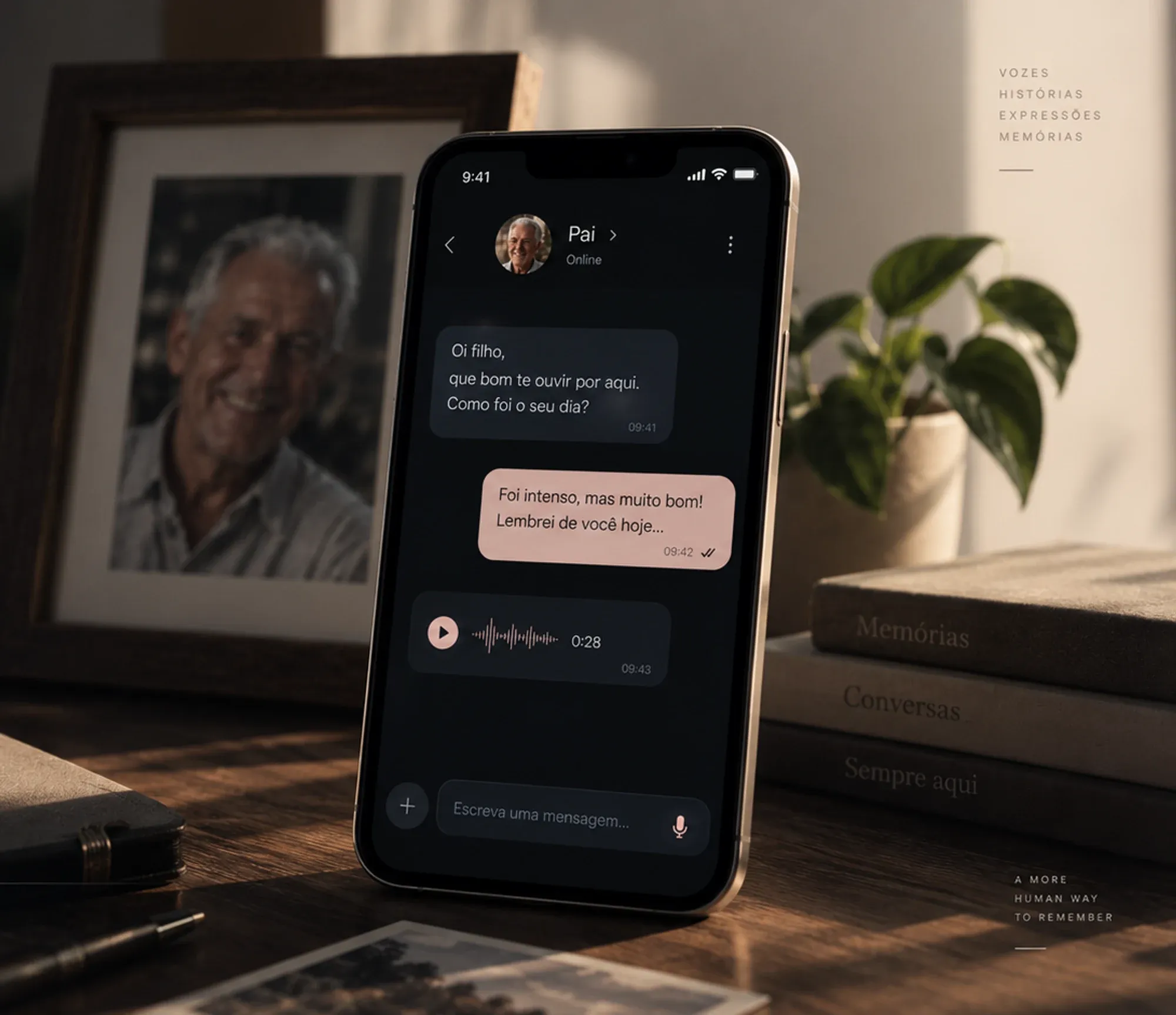
Product opportunity
From human context to product.
Photos and recordings preserve moments, but familiarity often lives in smaller details — voice, expressions, stories and the way someone communicates. That observation became the foundation of Norya: an AI product designed around preserving voice, expressions, stories, personality and memories. The challenge was turning those deeply human signals into an experience that felt understandable, controllable and familiar.
- Voice
- Expressions
- Stories
- Personality
- Memories
01 / Core product experience
Turning memory into an interaction model.
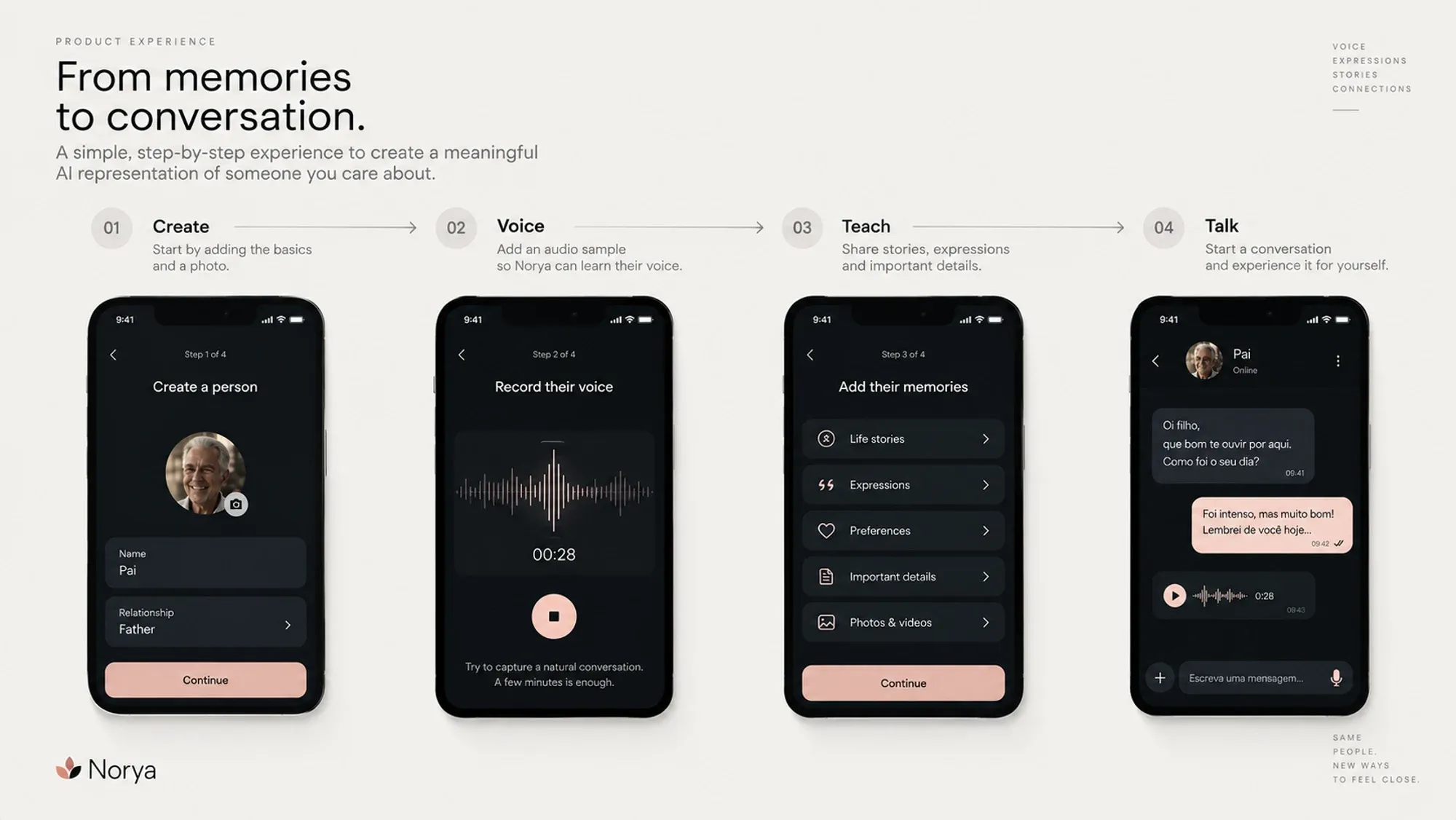
The key onboarding decision: instead of asking people to fully define someone before they can begin, Norya starts with enough context to create the representation and lets it become richer over time.
- 01CreateAdd the person and the relationship context.
- 02VoiceProvide audio so Norya can learn how they sounded.
- 03TeachAdd memories, expressions, stories and personal details.
- 04TalkStart a conversation through text or voice using interaction patterns people already understand.
02 / Designing familiarity
Complex AI. Familiar interactions.
Advanced AI capabilities shouldn’t require people to learn a new interaction model — Norya reuses patterns people already understand for both conversation and voice.
Conversation
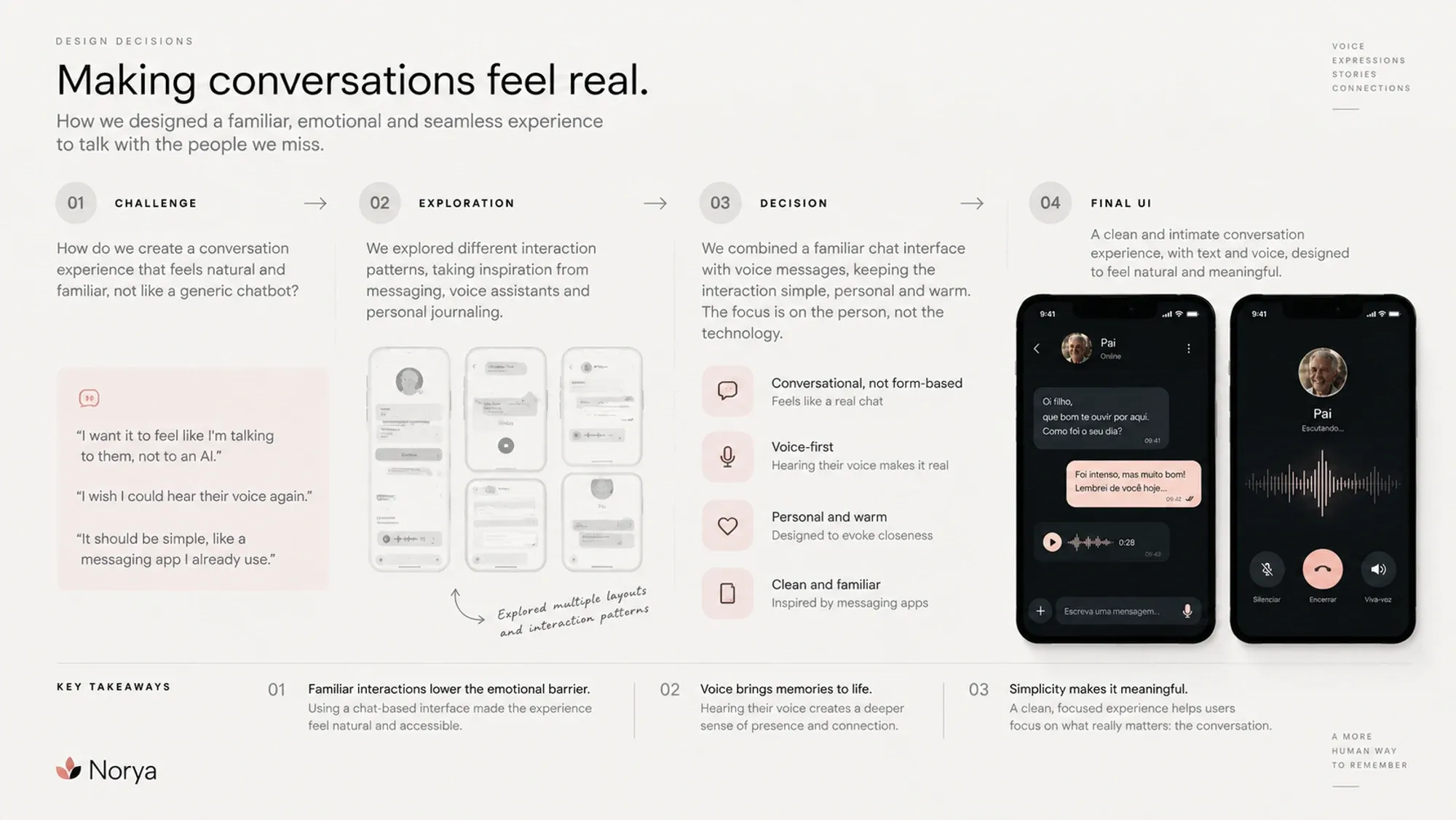
- Challenge
How do we make an AI conversation feel familiar, instead of asking people to learn another AI interface?
- Exploration
Explored familiar patterns — messaging, voice messages, conversational input, voice interaction — and prototyped several layouts.
- Decision
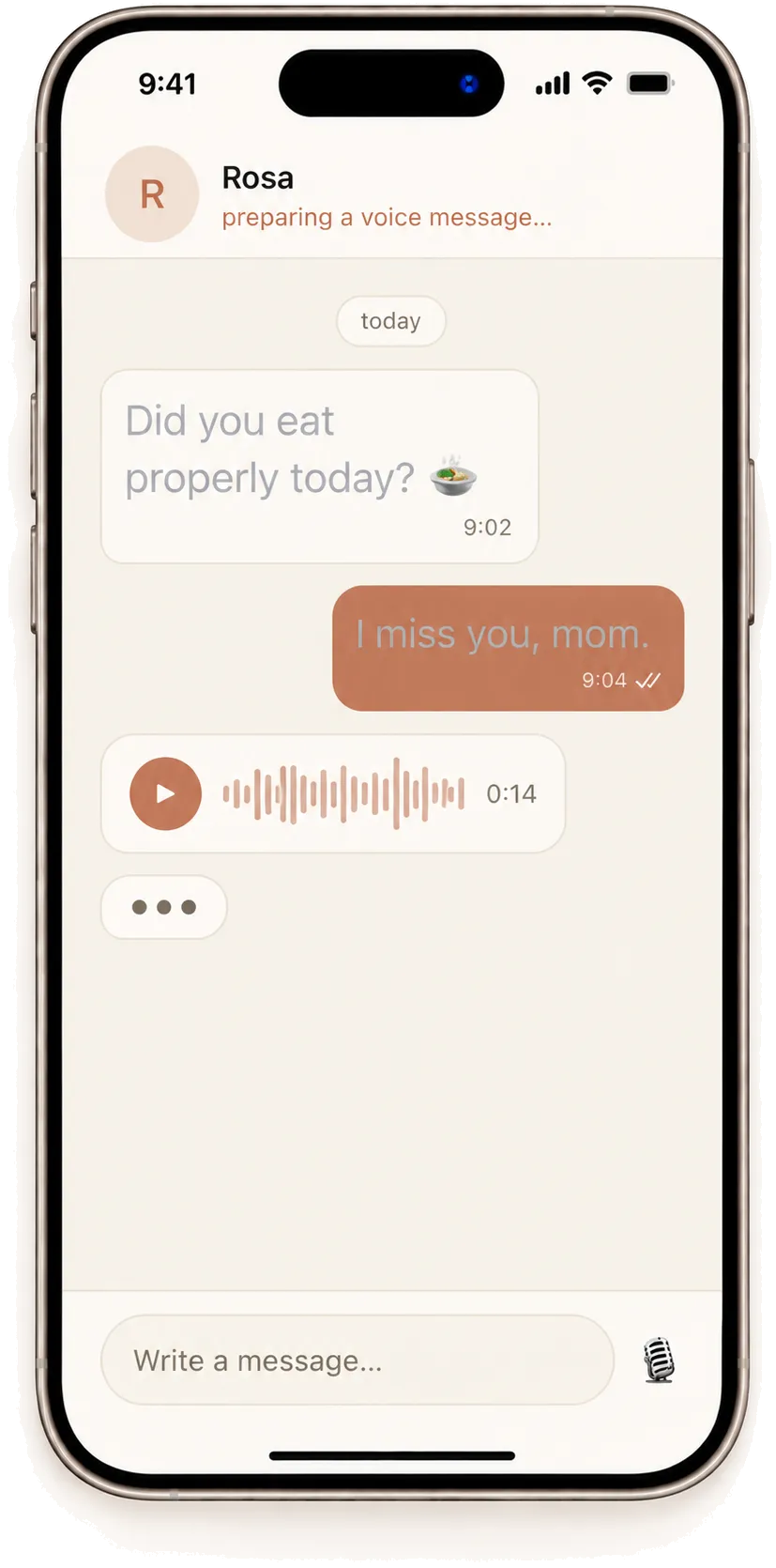
Reuse an interaction model people already understand: text and voice messages, in a chat.
- Why
Messaging is one of the most familiar forms of personal digital communication. Reusing those patterns cuts interface learning and keeps attention on the conversation.
Voice
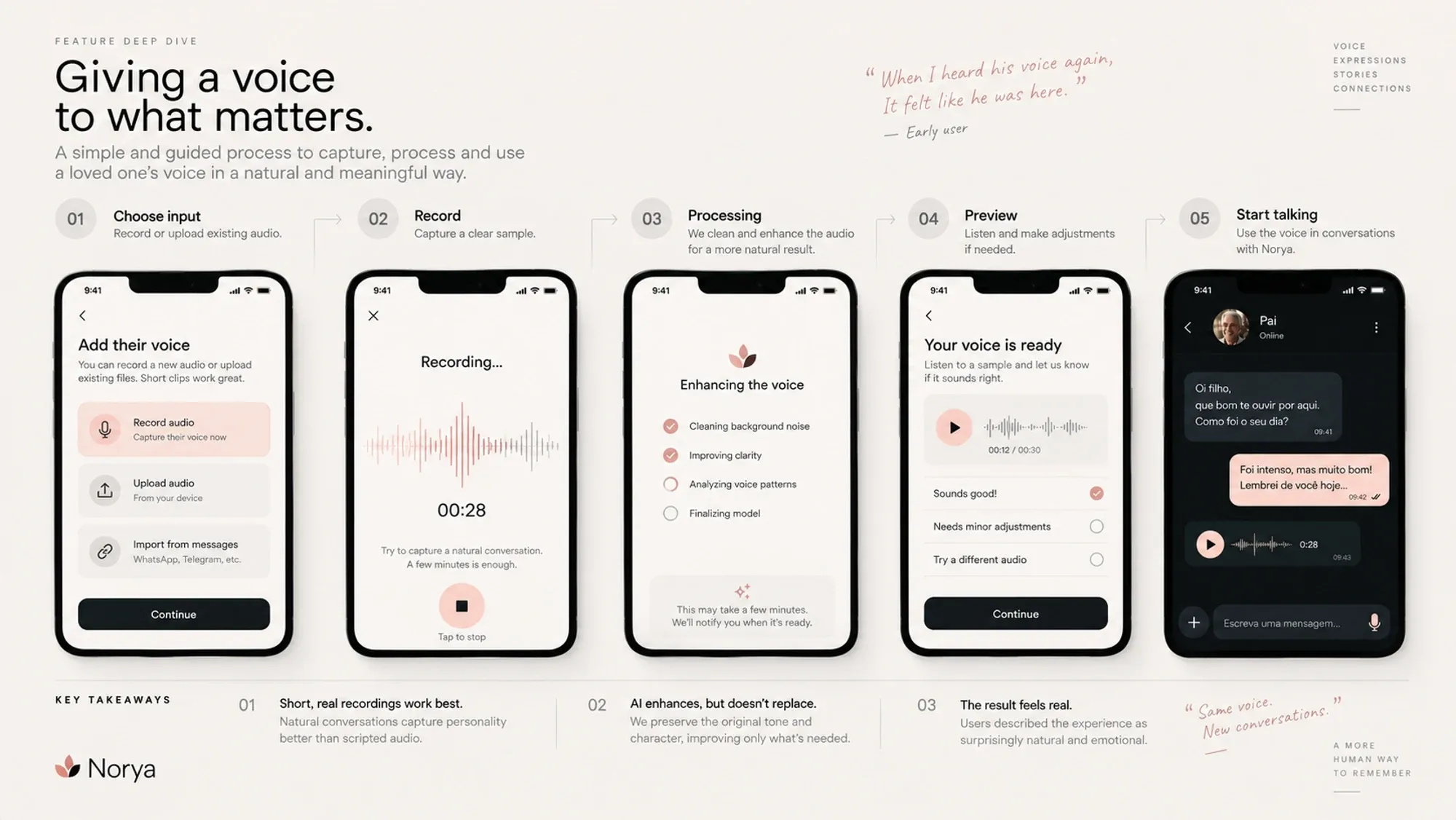
Voice AI is technically complex. A short, guided sequence — record, preview, approve — keeps that complexity out of view: what’s happening, what’s needed next, and confirmation before anything is used. From then on, replies can arrive as voice messages.
03 / Memory & control
A representation that gets richer over time.
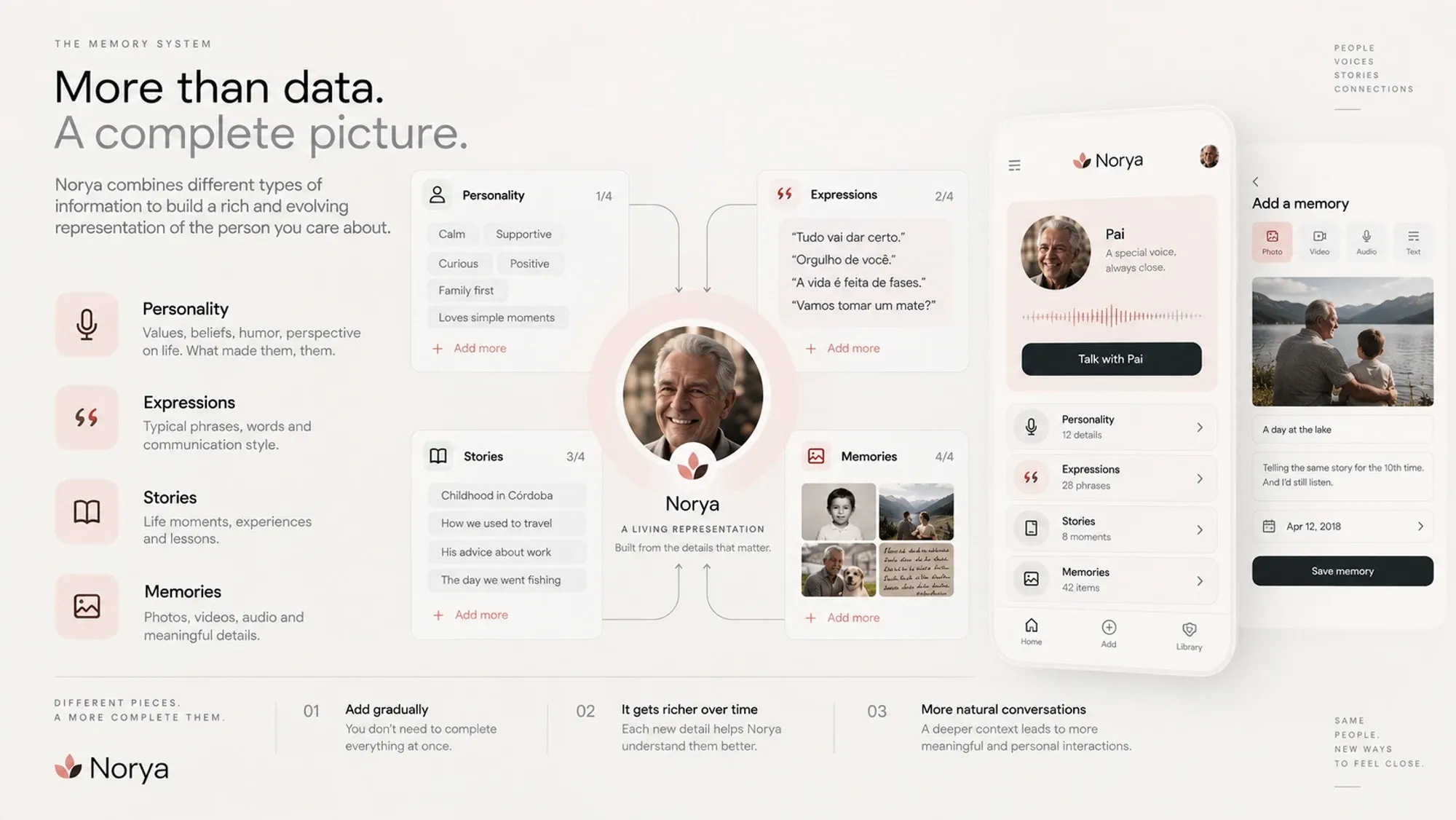
Instead of storing everything as one large biography, Norya separates personal context into dimensions — personality, expressions, stories, memories, voice — that people enrich a little at a time. Each addition becomes context the conversation can draw on, staying understandable as it grows.
But memory needs correction.
- Norya respondsIn persona, from the context it has so far.
- Something doesn't feel rightA phrase, a tone, a word they'd never use.
- You correct itIn the conversation itself — no settings screen.
- Norya learns the detailThe expression is saved back into the representation.
- Context becomes richerThe representation becomes more specific with each correction.
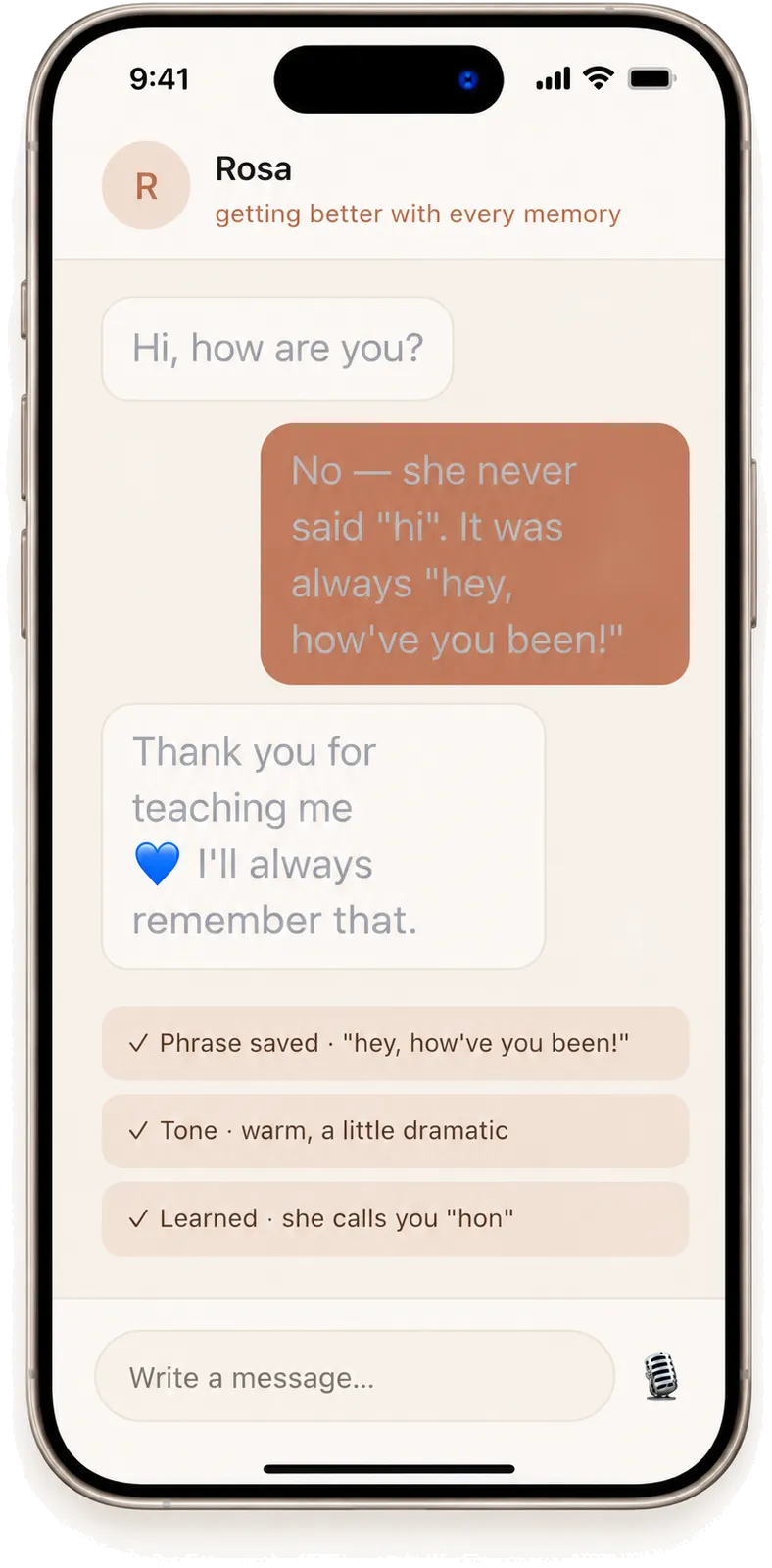
The user remains an active editor of the representation. Correcting a detail inside the conversation is enough — no settings screen, no separate review step.
A real correction. Norya opens with “Hi…” — not how she talked. You say so, in the chat, and the expression is saved straight into the representation.
04 / Responsible AI
Familiarity without deception.
Transparency
Norya is an AI representation built from context the user provides. It doesn't pretend the actual person is messaging.
Control
People decide what information, memories and audio become part of the representation — and can change it any time.
Familiarity
The interface avoids futuristic AI patterns. The person and the conversation stay in front of the technology.
05 / Design system
A system designed to stay out of the way.
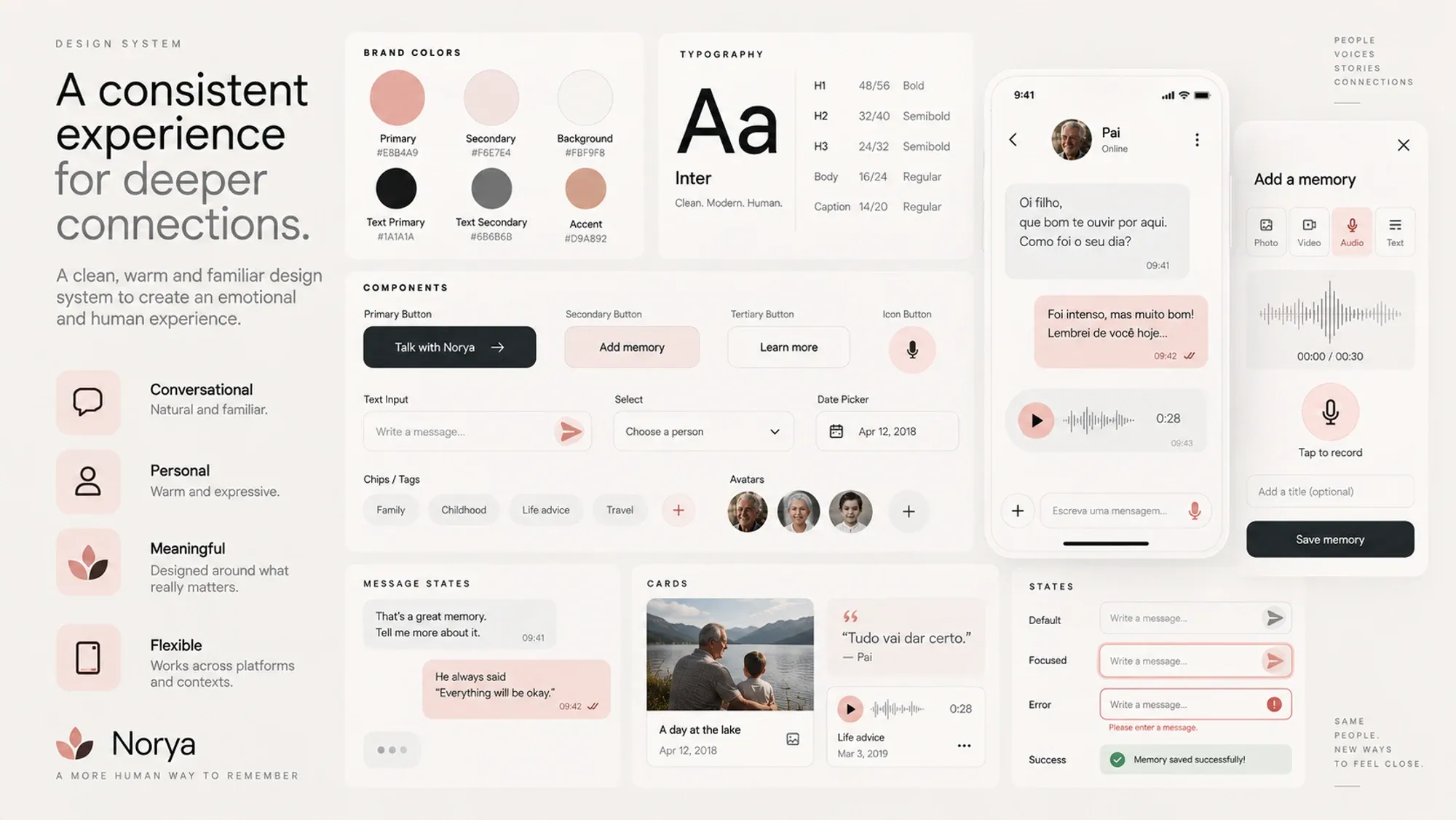
The interface avoids the usual visual language of AI products. It feels closer to a personal communication tool — warm off-white, one soft terracotta accent, generous type, almost no chrome.
06 / AI-native product building
From product direction to working software.
Instead of using one general-purpose assistant, I structured an AI-native workflow around shared product context, specialized roles and human ownership — then carried that same direction into implementation.
AI-native workflow
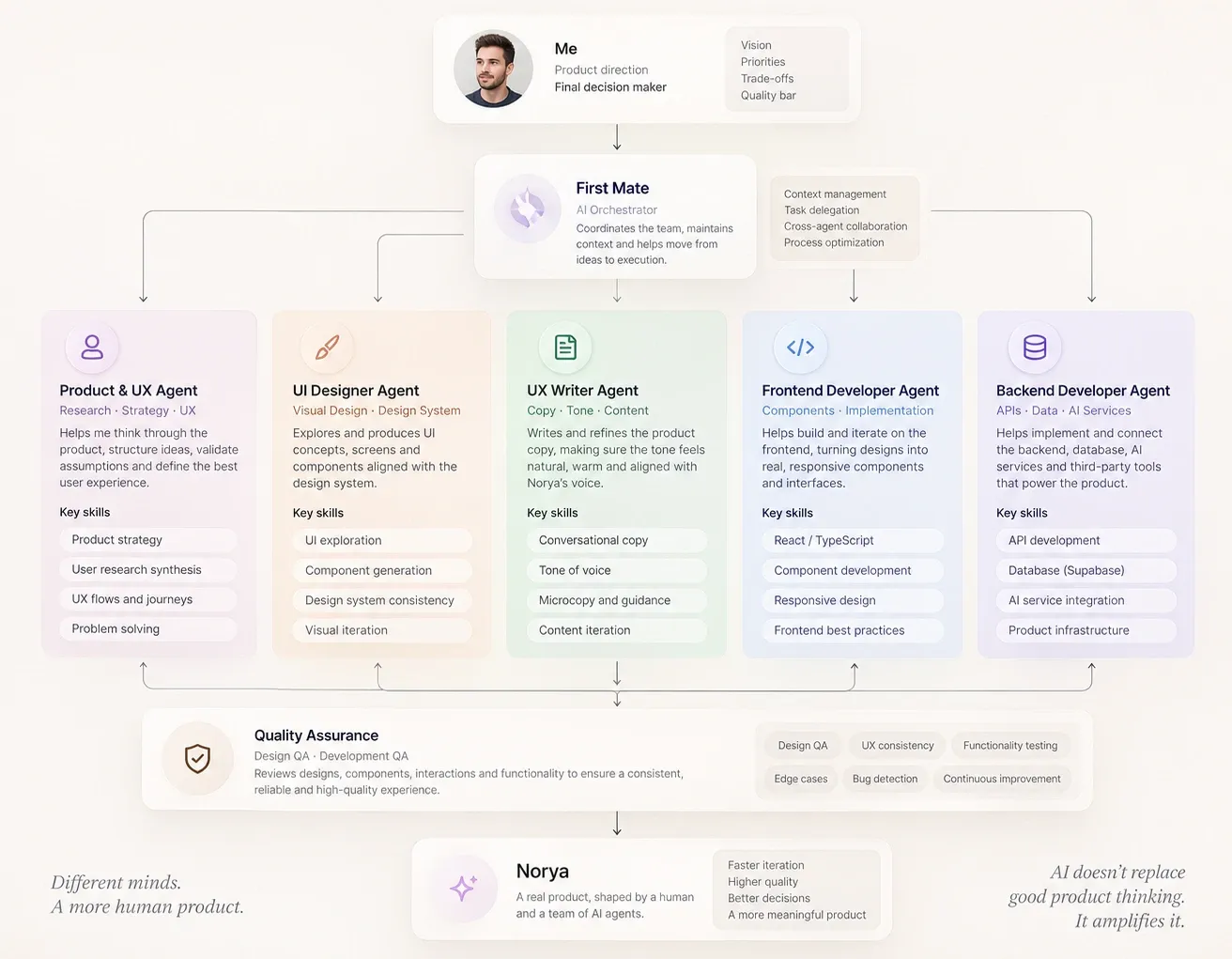
Level 01 — Direction
Me · product direction, final decisions
Vision, priorities, trade-offs and the quality bar. The agents don't make product decisions — that stayed with me.
Level 02 — Orchestration
First Mate · AI orchestrator
An orchestration layer between my direction and the agents — holding shared context, delegating work and keeping the disciplines aligned. Not a replacement for me.
Level 03 — Specialized agents
Product & UX · UI Design · UX Writing · Frontend · Backend
Validation — before it ships
Design QA + Development QA
Every agent's output passes through two checks: Design QA — spacing, type, components, responsive behavior, design-system alignment; and Development QA — functionality, edge cases, state handling, regressions.
↓ Norya — a real product, shaped by a human and a team of AI agents.
Each role worked from shared product context while focusing on a specific part of the problem. The First Mate coordinated execution so exploration, design and implementation remained connected.
- Shared context
- Specialized expertise
- Coordinated execution
Design didn’t stop at the prototype.
Design engineering
Norya became an opportunity to work across the complete product lifecycle — from the original product hypothesis and interaction model to the frontend, backend and AI services required to make the experience real.
- 01Product decision
- 02Interaction / system
- 03Component
- 04Code
- 05Shipped experience
Product architecture
Frontend
React · TypeScript · Vite · Vercel
Backend
Node · Express · WebSocket · Railway
Data
Supabase — auth · database · storage
AI & voice
Claude / GPT-4o · Whisper · Groq · ElevenLabs
Payments
Stripe
The frontend authenticates directly with Supabase; conversation, voice, memory and billing run through the backend.
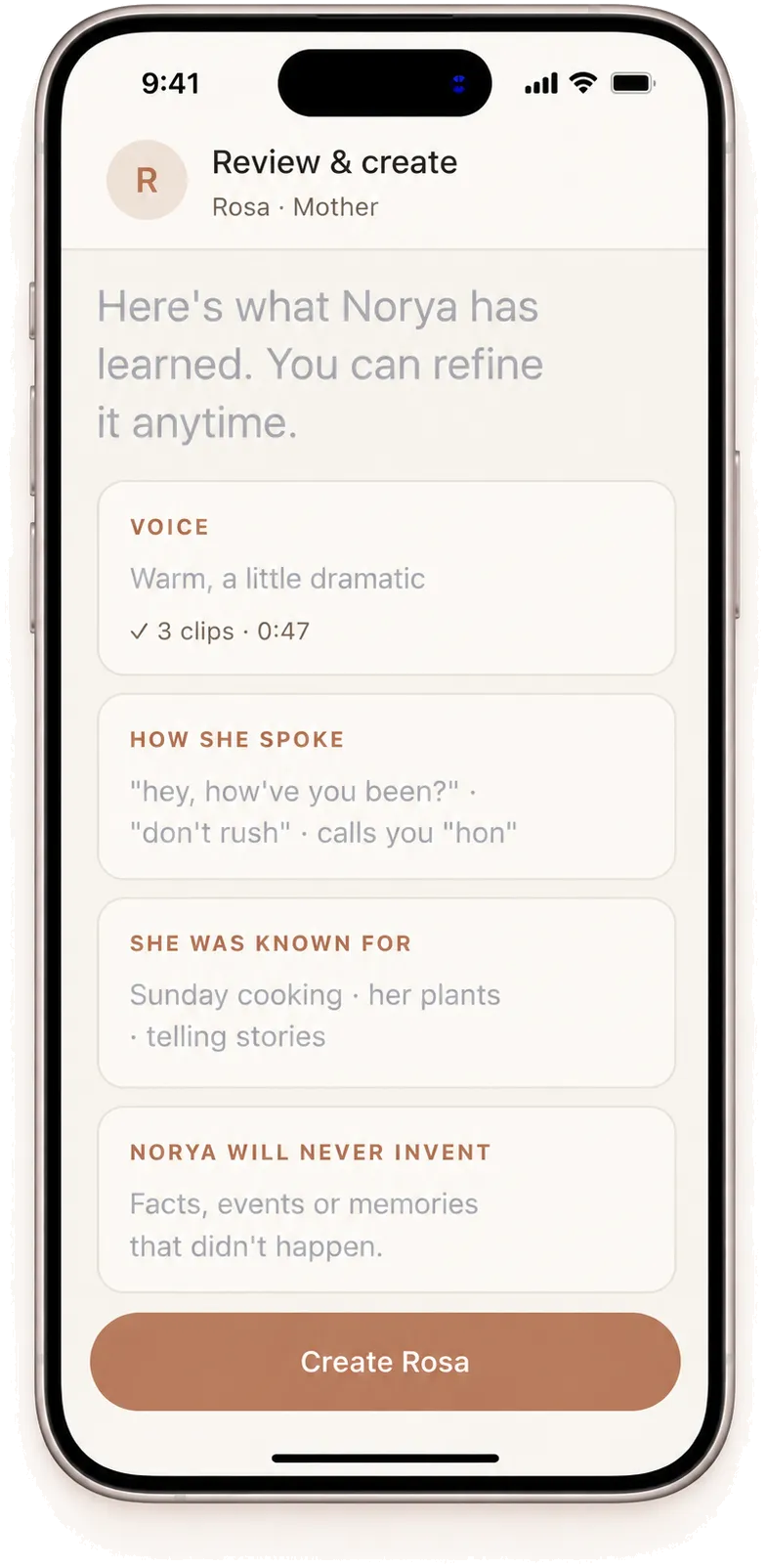
Design → component → shipped. The same person who set the interaction model built it — so the persona review beside this is the designed screen and the production component, not a redraw of one.
07 / Final experience
Designed, built and live.
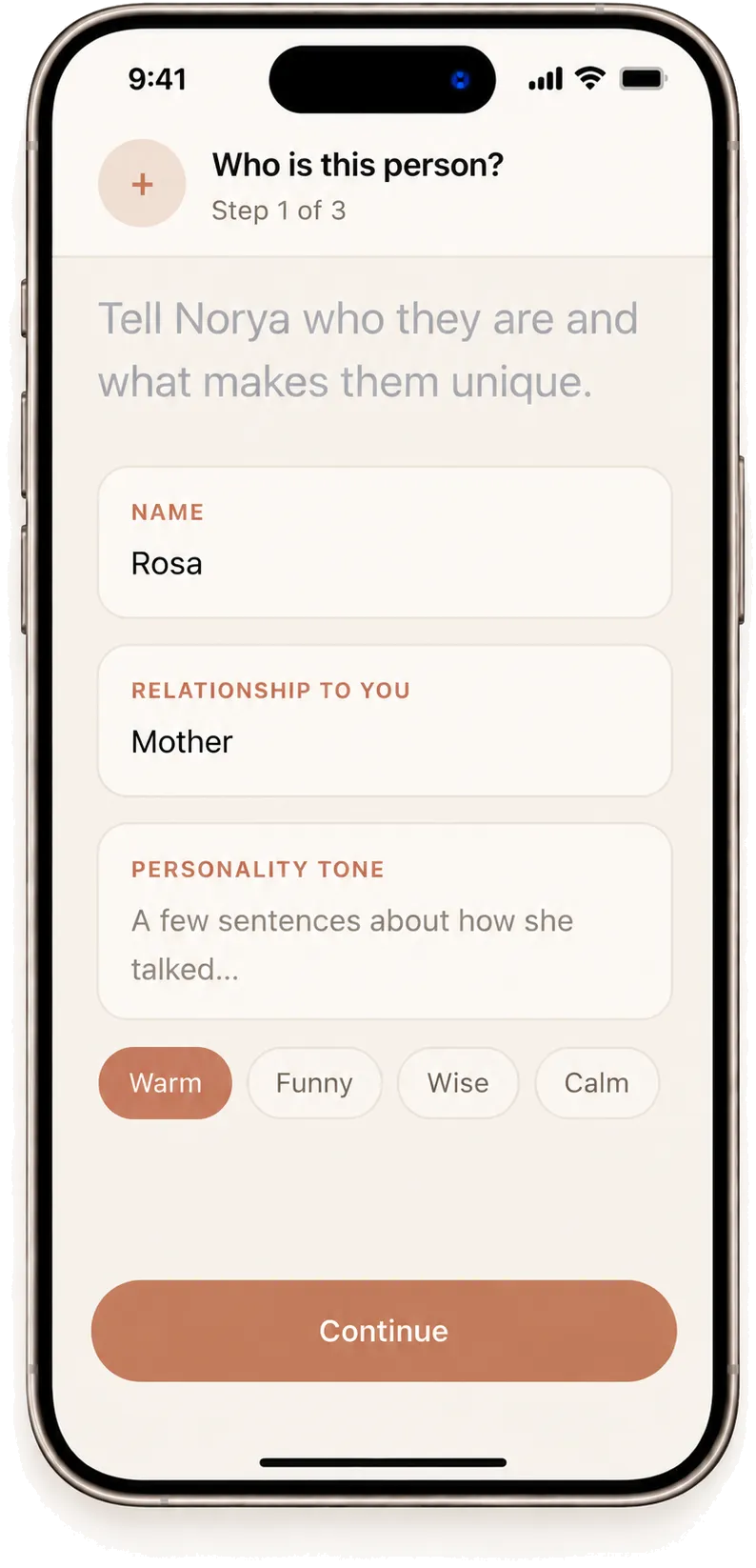
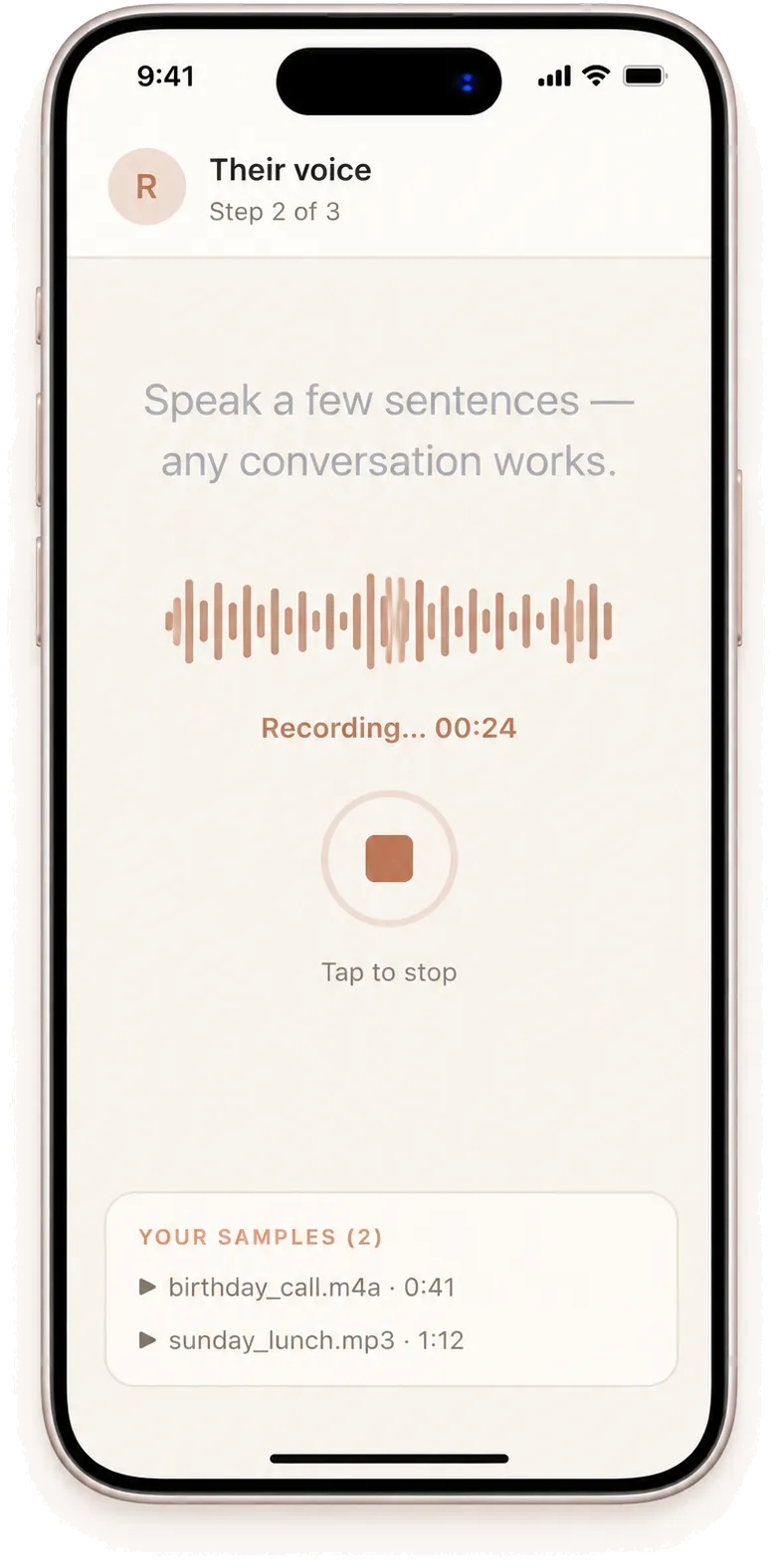
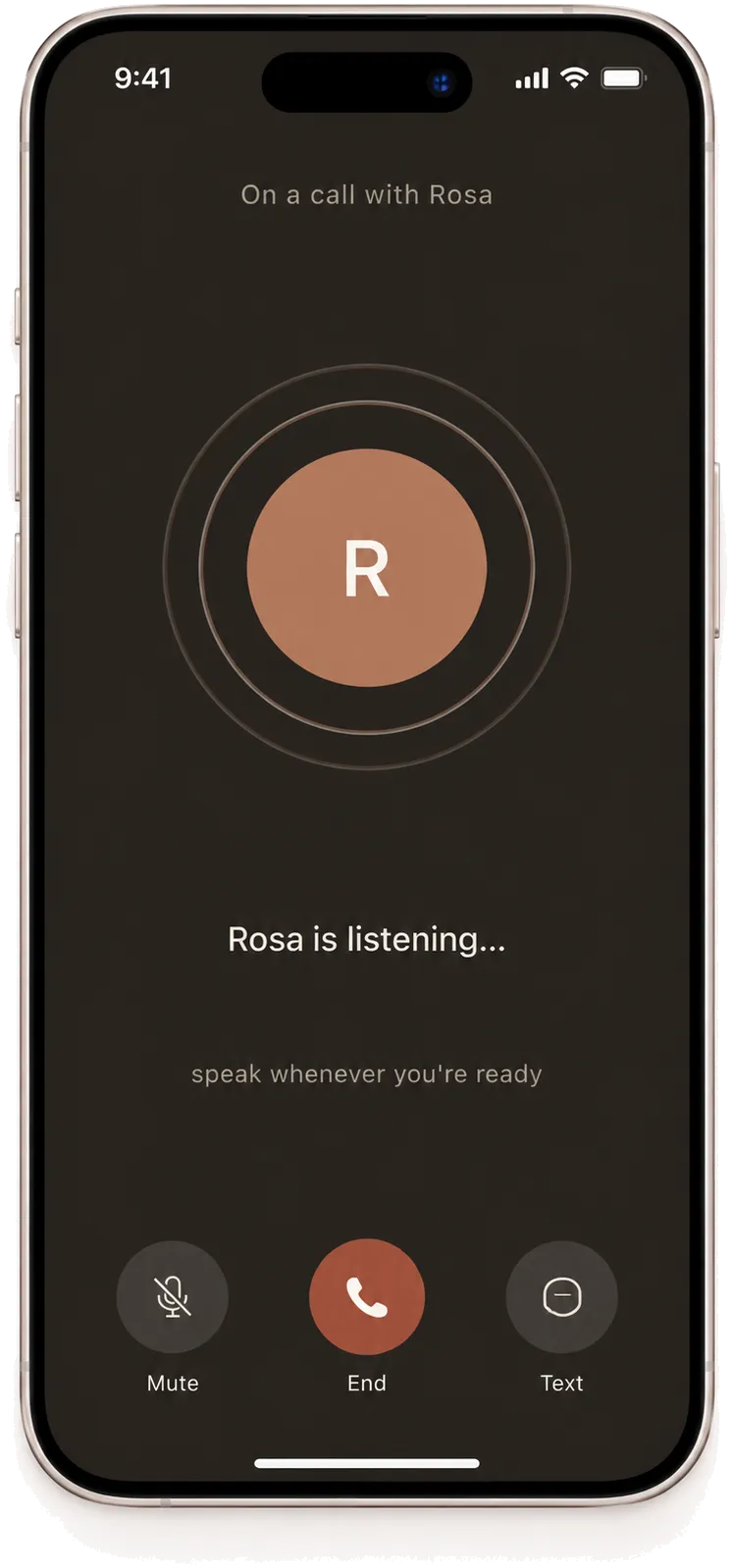
Interface reconstructed from the live product — person creation, voice, the conversation, voice calls and the persona review.
08 / Early validation
Then people started using it.
At this stage the value isn’t scale — it’s watching a highly personal idea become something other people choose to experience for themselves.
Shipping also changed the kind of questions I can ask. Real use now creates a chance to see where people want more guidance, what context they choose to add, and which parts of the experience deserve the next iteration — discovery doesn’t end at launch.
Discover → design → build → ship → learn ↺
Explore Norya09 / Learnings
The hardest part of AI isn't always the AI.
Familiarity reduces AI complexity
AI doesn't automatically require a new interaction model — reusing patterns people already understand cuts the learning curve to zero.
Memory needs user control
Personal context is never fully right the first time. Letting people correct it directly, inside the conversation, kept the representation improving instead of stalling.
Responsible AI requires transparency
Familiarity works because it stays honest about what it is. An AI representation that never claims to be the real person builds trust instead of spending it.
Design engineering closes the loop
Building beyond the prototype shortened the distance between product decisions, implementation and learning from real use.